Choose a good and how many you want each year. The tool walks the recipe tree down to raw materials, draws the chain as a diagram, and shows the buildings involved and how many production cycles each one has to run. The link in your address bar keeps the selection.
How to read the result
The diagram goes left to right from raw materials to the good you picked, and each arrow carries the yearly amount flowing into the next step. Under it, the first table is the chain as a tree. The good you picked sits at the top, and each indented line under it is an input. "Cycles per year" is how many times that building has to finish its recipe. For example, 240 bread a year means 24 bakery cycles (10 bread each), which needs 240 flour, which needs 24 windmill cycles and 240 grain. Raw goods at the bottom of each branch show where they come from: fields, mines, pits, animals or trade.
The raw materials table sums every branch. This is the number to check against your Annual Report or your stockpile. If a chain needs 120 coal a year and your mine makes 80, you know before you build the forge.
The buildings table groups the cycles by building. One building can run many cycles in a year, but the recipes do not say how long a cycle takes, and that depends on workers, walking distance and upgrades. Use the cycle count to compare chains, and watch the building's production over a year to see how many copies you need.
Chains worth knowing
 Bread: grain to flour at a Windmill (10 for 10), flour to bread at a Bakery (10 flour, 2 water and 1 firewood for 10 bread). The Windmill also costs 1 Heavy Tool to build.
 Heavy Tools: 15 iron ingots and 5 coal at a Blacksmith Forge. Each 5 ingots costs 5 iron ore and 2 coal at a Foundry, so one Heavy Tool needs 15 ore and 11 coal in total.
 Preserved vegetables: 8 root vegetables, 1 glassware and 1 firewood for 8 jars. Glassware is 4 sand and 1 coal, so preserving opens a sand and coal chain.
 Linen clothes: 10 flax per set at the Weaver. A 12x12 flax field at nominal output gives 864 flax, enough for 86 sets.
 Barrels: 2 iron ingots and 5 planks each. Barrels in storage make food last longer, so barrels are a food chain too.
Beer is the most input-hungry food-side good: every Brewery cycle takes 8 grain, 8 water, 2 honey and 1 firewood for 8 beer, so honey from Apiaries caps how much you can brew. 400 beer a year needs 100 honey.
Clothing and wear
Clothes and tools wear out while villagers use them, which is why the demand never stops. The wiki's Resources table gives a total wear life of 163 months for shoes, 217 for linen clothes, 231 for hide coats and 223 for tools; heavy tools last only 58 months in use. Shoes are the cheapest clothing per pelt: 1 pelt makes 2 shoes, while a hide coat takes 1 pelt and 2 water for one coat.
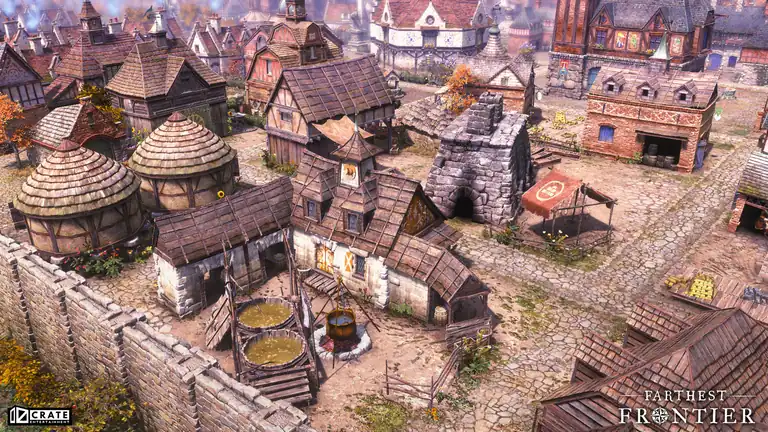
Worked example: tools for a growing town
Say you want 20 tools and 4 heavy tools a year. Tools: 20 x 5 = 100 ingots and 40 coal at the forge. Heavy tools: 4 x 15 = 60 ingots and 20 coal. That is 160 ingots, which the Foundry makes in 32 cycles from 160 iron ore and 64 coal. Total coal is 40 + 20 + 64 = 124 a year. Pick "Tools" in the lookup with 20 and "Heavy Tools" with 4 to see each half, then add them.
Recipes come from each item's page on the community wiki. Coal from the Charcoal Kiln is left out because the wiki gives two different ratios for it. For what every good is used for, see the resources list.
Production questions
How do you make heavy tools in Farthest Frontier?
At a Blacksmith Forge: 15 iron ingots and 5 coal make 1 heavy tool. The ingots come from a Foundry (5 iron ore and 2 coal make 5 ingots). Both buildings need Town Center tier 3 and 1 heavy tool each to build, so buy the first ones at the Trading Post.
How do you make barrels?
At a Cooper (Town Center tier 3): 5 planks and 2 iron ingots make 1 barrel. A barrel lasts 123 months once in use.
How do you make beer?
At a Brewery (Town Center tier 3): 8 grain, 8 water, 2 honey and 1 firewood make 8 beer. Beer goes to the Pub.
How do you make bricks?
At a Brickyard (Town Center tier 3): 5 clay and 2 coal make 5 bricks.