Type your population and pick the apartment block you build most. The calculator gives the daily and yearly demand for the five consumer goods citizens buy in shops, how many factories cover it, and what that housing needs in electricity and water. The link it builds into the address bar keeps your inputs, so the numbers can be shared.
Where the consumption figures come from
The figures come from a Steam forum post (October 2021) that summarises a Reddit discussion of one republic of 109,478 citizens: 13,618.61 t of food, 3,039.5 t of meat, 900.53 t of electronics, 511.07 t of clothes and 996.37 t of alcohol in one year. Divided out, that is about 124.4 kg of food, 27.8 kg of meat, 8.2 kg of electronics, 4.7 kg of clothes and 9.1 kg of alcohol per citizen per year. The calculator scales those averages to your population.
Two cautions. First, the sample is from early access, before version 1.0, so the game may have changed since. Second, it is one republic's average, reported by players rather than taken from the game files. Use it to size the first factory, then read your own shop statistics and adjust.
Factories per population
A food factory makes 20 t of food a day when fully staffed by its 170 workers. At 124.4 kg per citizen per year, that covers a little under 59,000 citizens on paper. Players on the Steam forum put it at about 40,000 people per food factory in practice. Plan with the lower forum figure and you will not run short. Clothing is cheaper: one clothing factory (1.2 t a day) covers roughly 94,000 citizens on the measured average, and one distillery (6 t a day) covers far more than any early republic needs, which is why alcohol is a common export.
Power and water for housing
The housing figures come from the wiki's residential buildings table, which lists each block's maximum power use per day, maximum water use per day and resident cap. Water is very consistent: about 0.045 m³ per resident per day for nearly every block. Power is about 0.06 MWh per resident per day for blocks of 50 residents or more, but small blocks have a floor of 3.0 MWh each, so a 12-resident brick block costs four times as much power per person as a big prefab block. If power is tight, build bigger.
These are maximums for homes only. Shops, schools, hospitals and every factory draw their own power, so take the housing figure as a floor and add your industry from the production chain calculator before you size plants.
How the goods reach the shops
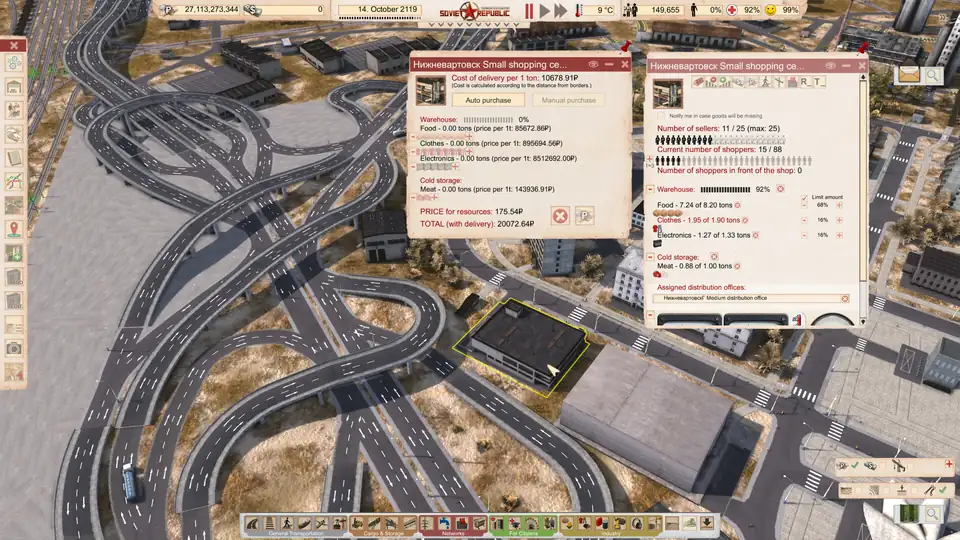
Factories do not sell to citizens directly. Goods go from the factory to a warehouse, then distribution office trucks carry them to shops, where citizens buy them. The shop window in the screenshot shows the four goods with their own stock bars (food, clothes and electronics in the warehouse, meat in cold storage) and an auto-purchase option that buys from abroad at a delivery cost per tonne. Alcohol is sold through shops as well; the wiki's alcohol page lists shops as its use.
The calculator gives what citizens consume. Warehouses and shop stock hold goods on top of that, so expect a new district to soak up extra output while its shelves fill.
Clothes, the cheapest good to make
 One clothing factory with 80 workers makes 1.2 t of clothes a day from 2.4 t of fabric, enough for roughly 94,000 citizens on the measured average. The whole chain back to the fields looks like this:
Questions
How much food does one citizen eat?
About 124 kg a year, or 0.34 kg a day, from the player-measured sample of 109,478 citizens. The wiki adds that a citizen takes 1.5 kg of food per shopping trip.
How many citizens does one food factory feed?
About 58,700 on paper (20 t a day, 7,300 t a year, divided by 124.4 kg). Players on the Steam forum report about 40,000 in practice, so plan with the lower figure.
Why is there no meat or electronics factory count?
The wiki has no complete figures for the slaughterhouse or the electronics factory yet. The calculator still shows how many tonnes you need, so you can size imports.
Which housing is cheapest to power?
Big prefab blocks. Every block draws at least 3.0 MWh a day, so small blocks cost far more power per resident. Water stays near 0.045 m³ per resident a day whatever you build.