Choose the good you want and how many tonnes per day you need. The calculator works backwards through every input until it reaches a raw resource (a field, quarry, mine, woodcutting post or pumpjack) or something you have chosen to import. The result shares through the address bar, so you can send a planned chain to a friend or bookmark it.
How to read the results
Exact is the fractional number of buildings the target needs at full staffing. Build rounds it up. Workers, power and water are worked out from the exact number, so they match what the chain uses rather than what the rounded buildings could use. A total with a + means at least one building in the chain has no power or worker figure on the wiki, so the true total is a little higher.
The chain diagram under the buildings table draws the same chain: goods on the left flow into buildings on the right, each arrow labelled with the tonnes per day it carries, and each building box shows the exact count. Imported goods are marked, and by-products such as bitumen appear as end boxes. Click any building box to open its row in the buildings table.
The goods table shows every tonne that has to move between buildings each day. That is the number to size your trucks, trains and conveyors for. A food factory alone pulls 42 t of crops a day, plus the 20 t of food going out.
Import or build?
Every input in the chain has an Import box. Ticking it stops the chain there and treats that good as bought at the customs house. One way to start: import crops for the first food factory, import fabric for the first clothing factory, and replace imports one link at a time as workers become available. Watch the worker total drop when you tick chemicals or oil on a fabric chain to see what that link costs you in people.
Fields and seasons
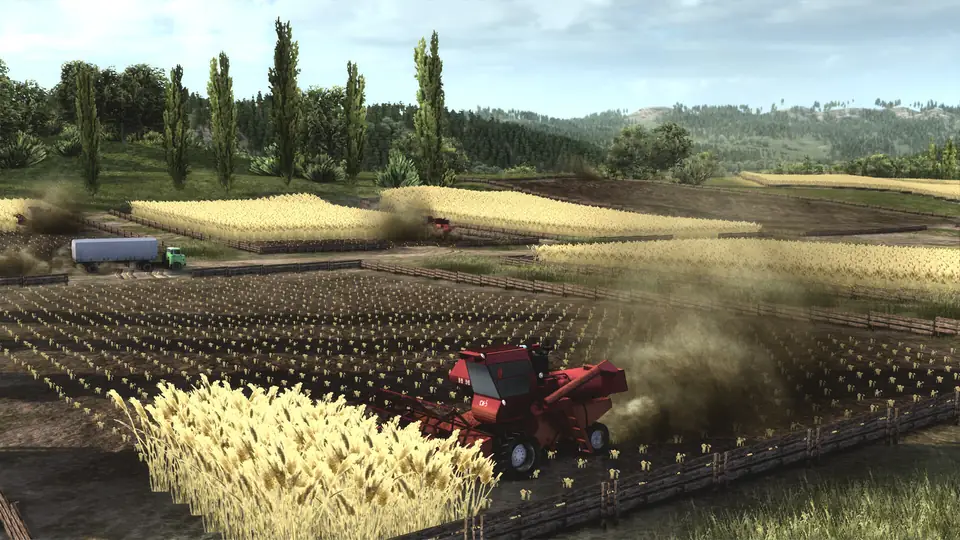
Crops come from fields, and the wiki lists field yield per harvest at 100% fertility: 33 t for a small field, 100 t for a medium field and 300 t for a big field. With seasons on there is one harvest a year, so the calculator spreads that harvest over 365 days. A big field therefore counts as about 0.82 t of crops per day. Players on the Steam forum report about 300 t a year from a big field, which matches. The wiki says a new field starts at 70% fertility, so expect less until fertility rises or you fertilise. Without seasons there is more than one harvest a year, so the field count is the cautious case there. The wiki lists up to 75, 150 and 250 workers per field. That is a ceiling rather than a fixed crew, so the calculator leaves field workers out of the worker total.
Building variants
Some goods have two buildings that make them. The gravel processing plant (15 workers, 82 t a day) and the small gravel processing plant (5 workers, 27 t a day) both turn quarried stone into gravel at roughly the same ratio, but the small one needs far fewer people per building. The large chemical plant came with patch 0.9.0, per the wiki. Switch variants in the options box and the whole chain updates.
Worked example: 43 t of steel a day
Pick steel at 43 t a day, one full  steel mill. It needs 200 t of iron and 357 t of coal a day. Iron comes from iron ore processing plants at 105 t each from 225 t of ore, so 1.90 plants and 429 t of ore, which is 0.43 of an iron mine (1,000 t a day). Coal needs 2.98 coal ore processing plants (120 t each from 210 t of ore) and 625 t of coal ore, 0.68 of a coal mine. The calculator totals about 829 workers before you add housing, shops and transport crews: 500 at the mill, about 29 and 45 at the two processing plants and about 107 and 149 at the two mines. Tick Import coal and the total drops by about 193, to 636.
Known gaps
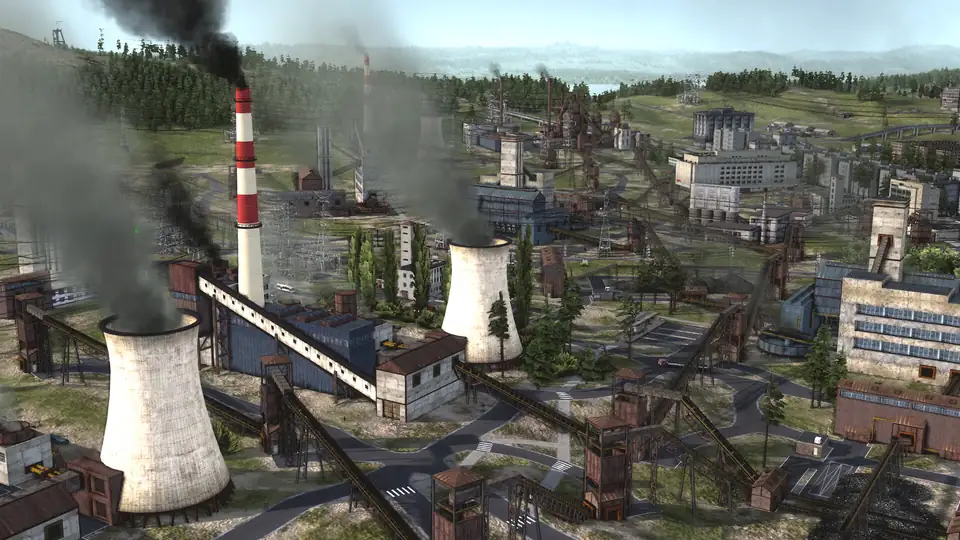
The oil refinery always makes fuel and bitumen together (125 t and 75 t a day from 250 t of oil), so a fuel chain shows bitumen as a spare by-product. Meat, electronics, electronic components, aluminium and explosives are not offered because the wiki does not yet list complete input figures for the buildings that make them. The brick factory is listed with coal as its only input because that is what the wiki shows.
The plastics factory, mechanical components factory and the three nuclear fuel plants come from the wiki's resource pages, which give rates but no worker or power figures, so their rows show "not listed" and the totals carry a +. Bauxite and uranium ore have no producer figures, so they are treated as raw inputs.
Questions
Why is the Build number higher than Exact?
You cannot build 0.43 of a mine. Build rounds each building up, and the spare capacity is yours to export or grow into. Workers, power and water are worked out from Exact so the totals show what the chain really uses.
Does the calculator include workers for fields and pumpjacks?
No. Field workers on the wiki are a maximum, not a crew, and the wiki lists no crew for the pumpjack. Their rows show "not listed".
How do I plan for a building that is short of workers?
Output scales with staffing, so a building at 70% staff makes about 70% of the listed amount. Divide your target by your expected staffing level (for example 20 / 0.7) and enter that instead.
Can I share a plan?
Yes. The address bar holds the good, rate, imports and building choices. Copy it, or use the Copy share link button.