Farming in Workers & Resources is two kinds of building working together: a farm holds the tractors, harvesters and trucks, and the fields assigned to it grow the crops. A livestock farm is a separate building that turns crops into livestock. This guide puts the official wiki's farming figures in one place and works out how many fields each factory needs.
Field sizes and yields
| Field | Area | Yield per harvest at 100% fertility | t per hectare | Max workers |
|---|---|---|---|---|
 Small field Small field | 0.36 ha | 33 t | 92 | 75 |
 Medium field Medium field | 1.57 ha | 100 t | 64 | 150 |
 Big field Big field | 4.81 ha | 300 t | 62 | 250 |
Two things stand out. First, the small field gives the most crops per hectare on paper (about 92 t against 62 t for a big field), so if land is tight and you can fit many small plots, they use the ground better. Second, the big field is still the easiest to run: one road access and one loading spot each, and you need nine small fields to match one big one. Most players build big fields and fill gaps with small ones.
With the seasons game setting on, you get one harvest a year. Without seasons, fields grow more than one crop a year, so the counts below are the cautious case.
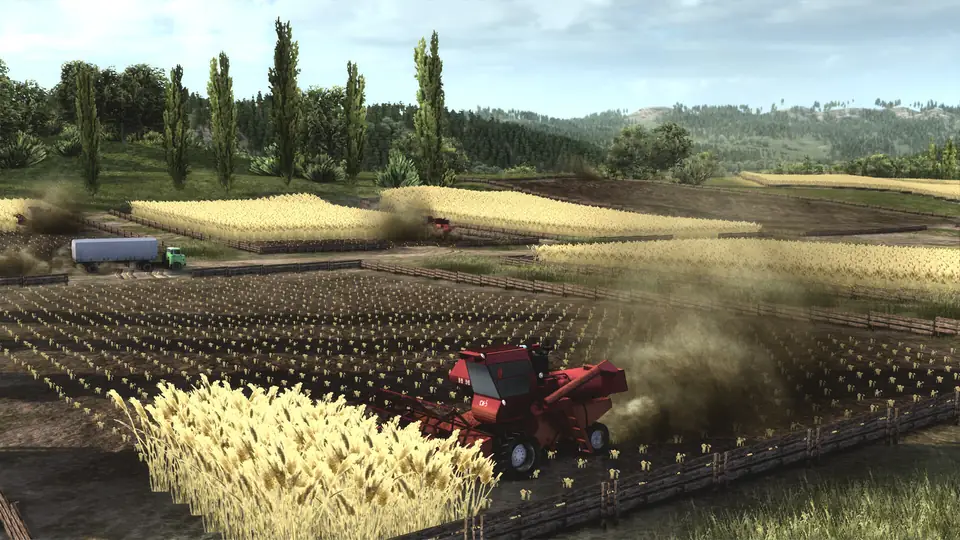
Small, medium or large farm
Crop farms have no workers of their own in the wiki's table; the people work on the fields. What changes with size is how many vehicles and how much stock the farm can hold:
| Farm | Vehicle parking | Crops storage | Fuel storage | Fertiliser storage | Factory connections |
|---|---|---|---|---|---|
| Small farm | 6 | 40 t | 12 t | 40 t | 2 |
| Medium farm | 12 | 76 t | 25 t | 75 t | 4 |
| Large farm | 30 | 144 t | 45 t | 135 t | 8 |
All three draw 3.0 MWh a day. The large farm costs the most to build (2,575 workdays, 117 t of concrete, 90 t of gravel, 72 t of asphalt and 61 t of steel, per the wiki) against 843 workdays and 28 t of steel for the small farm. The large farm's 30 parking spots are the real gain: sowing tractors, harvesters and trucks all need a space, and a farm with too few vehicles leaves fields unworked.
Fuel is the input people forget. Every tractor and harvester burns it, and the farm stores only 12 to 45 t. Deliver fuel to the farm, or the whole operation stops mid-harvest.
Grain storage
A grain storage holds 800 t of crops, uses 3.0 MWh a day and connects to the farm by factory connections. The wiki notes its road and factory connections sit close together, so leave room when placing one next to a farm. A farm's own store is small (144 t at most) next to a big field's 300 t harvest, so a farm working several big fields needs grain storage or a steady truck run to the factory.
How many fields per factory
Daily crop use from each building's wiki page, times 365, divided by 300 t per big field per harvest (one harvest a year with seasons on):
 Food factory: 42 t a day = 15,330 t a year = about 51 big fields (153 medium or 465 small).
 Distillery: 30 t a day = about 37 big fields.
 Fabric factory: 20 t a day = about 24 big fields.
 Livestock farm: 20 t a day = about 24 big fields.
Those counts assume 100% fertility. New fields start at 70%. If yield falls in step with fertility, a 70% big field gives about 210 t, and a food factory then needs about 73 big fields. A player on the Steam forum counted 51.06 big fields per food factory, which matches the full-fertility figure.
Fertility and fertiliser
A new field starts at 70% fertility and rises slowly on its own. Fertiliser (solid or liquid, added in patch 0.8.9) raises it faster. In the farm's window you set a minimum fertility; when a field drops below it, a tractor goes out and fertilises it, sometimes over several trips. Each field also has a nutrient level that falls as crops grow and rises when fertiliser goes on. Keep fertiliser in the farm's store (40 to 135 t) so tractors are not waiting.
Livestock farms
A livestock farm is a different building with 50 workers. It takes 20 t of crops and 12 m³ of water a day (plus 2.3 m³ for the workers) and gives 10 t of livestock and 14.8 m³ of wastewater. It stores 60 t of crops and 26 t of livestock. A livestock hall/range adds 225 t of livestock storage. The wiki warns that drinking water quality must be 97% or higher to keep the workers in good condition. The livestock go on to a slaughterhouse for meat, which the wiki has no figures for yet.
Questions
How many fields per farm?
The wiki gives no fixed number. The limit in practice is vehicles: a farm only works as many fields as its tractors and harvesters can cover in time. Large farms park 30 vehicles, small ones 6. Start with a few big fields per farm and add more while the harvest still finishes on time.
How many fields does a food factory need?
About 51 big fields at 100% fertility with seasons on, from 42 t of crops a day and 300 t per harvest. Plan for more while fields are still near their 70% starting fertility.
Small fields or big fields?
Small fields give about 92 t per hectare against 62 t for a big field, but you need nine of them per big field, each with its own access. Use big fields for bulk and small ones for leftover land.
Do farms need power and workers?
Each farm and grain storage draws up to 3.0 MWh a day. The wiki lists no workers for crop farms themselves; the jobs are on the fields (up to 75, 150 or 250 workers by size).
Should I import crops instead?
Early on, often yes: 51 big fields is a lot of land, vehicles and fuel. Import crops to run the factory, and build farms once you have spare workers.
Plug a factory into the production chain calculator to see the field count with workers, power and water, or see every crop consumer in the resources list.